

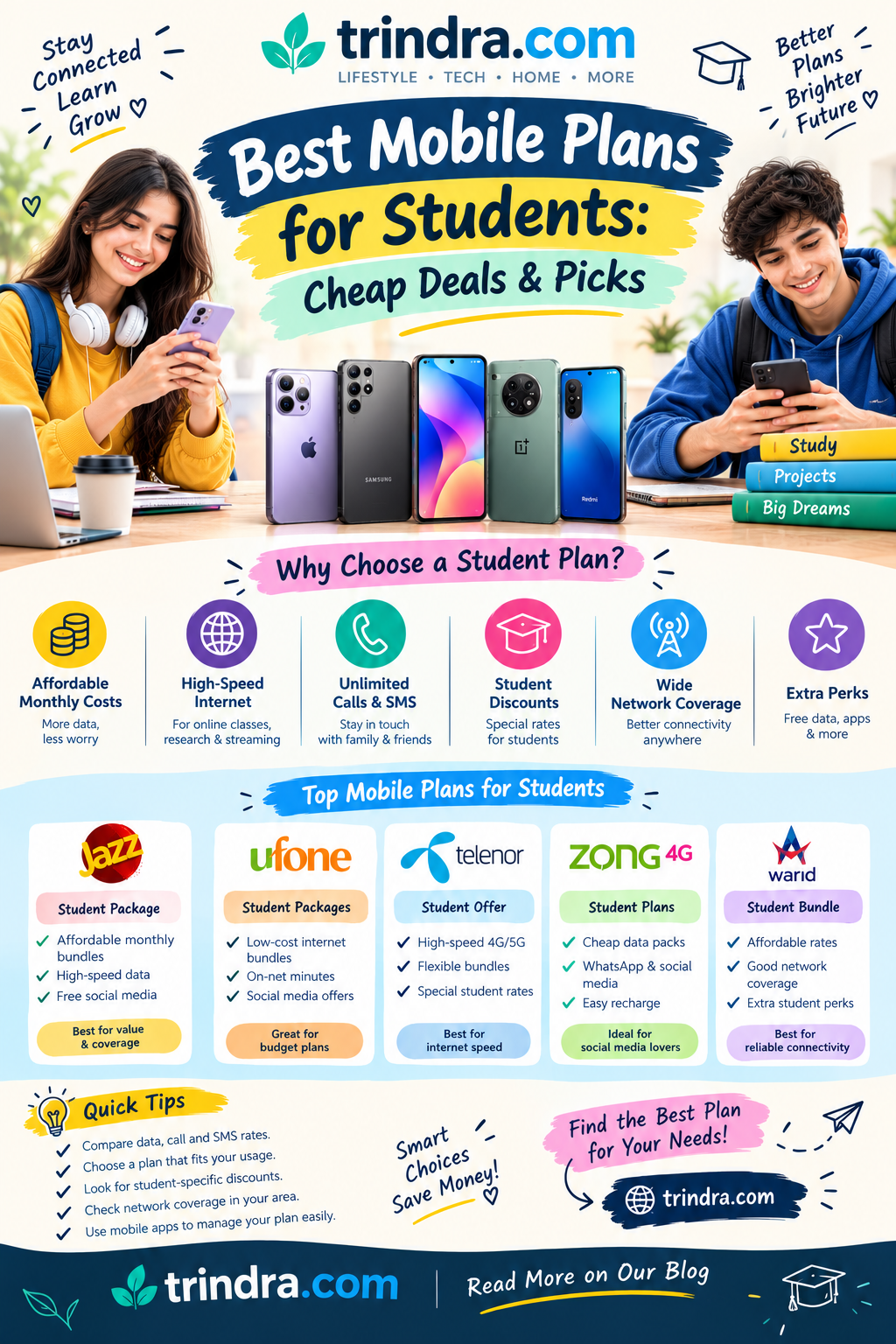
Best Mobile Plans for Students: Cheap Deals & Picks
Best Mobile Plans for Students: Cheap Deals, Discounts and Top Picks
Students need a phone that works all day, but they rarely have a big budget. Between classes, group chats and part-time jobs, a good connection matters a lot. That is why choosing the best mobile plans for students can save both money and stress.
In this guide, you will first learn what to look for in a plan. Next, you will see the main service types and ways to save. Finally, you will find phone suggestions, family options and answers to common questions.
What Makes the Best Mobile Plans for Students?
Not every plan suits a student lifestyle. Therefore, it helps to know which features matter most.
Affordable Monthly Price
Most people in college want a low and predictable bill. For this reason, plans without hidden fees are usually the smartest choice.
Enough Data for Daily Use
Streaming lectures and using maps both use data. However, many learners spend most of the day on campus Wi-Fi. As a result, a mid-sized data allowance is often enough.
Reliable Coverage
A cheap option is useless if the signal drops in your dorm. So, always check the coverage map for your campus and home before you sign up.
Flexible Contracts
Young adults often move or travel. Because of this, no-contract deals are usually better than long agreements.
Types of Service You Can Choose From
Understanding the basic types makes comparing much easier. Among the best phone plans for students, three categories stand out.
Prepaid Options
Prepaid service is paid in advance, so there are no surprise bills. Also, it often costs less than postpaid service.
Postpaid Options
Postpaid service bills you after you use it. Although it can cost more, it often includes phone financing and extra perks.
Budget Carriers
These smaller carriers use the networks of big providers. Consequently, they can offer similar coverage at a lower price. For many people, this is the sweet spot.
What to Compare Before You Buy
Before you pick the best cell phone plan for students, compare a few key points. First, look at the monthly cost after taxes and fees. Second, check how much high-speed data you actually get. Third, see whether hotspot use is included, since it is handy for laptops. Finally, read what happens after you pass your data cap.
Ways to Keep Your Bill Low
If money is tight, cheap cell phone plans for students are easy to find. However, the lowest price is not always the best value. For example, a very cheap option may slow down quickly or lack good coverage.
Here are simple ways to keep costs low:
- Choose prepaid or budget carrier service.
- Pick a smaller data bucket if you use Wi-Fi often.
- Turn on autopay to unlock small monthly savings.
- Avoid extras you never use.
Discounts and Deals Worth Watching For
Many providers reward learners with special pricing. Therefore, it is worth asking before you buy. Phone plans with student discounts may include lower monthly rates, free extras or bonus data.
To qualify, you usually need proof of enrollment. For instance, a school email address or ID card often works. Since offers change often, check the provider’s website for the latest terms.
Meanwhile, student phone deals appear all year. Back-to-school and holiday sales often bring strong offers, and new phone launches can lower the price of older models. However, read the fine print carefully. Some deals require you to stay for 24 or 36 months. Otherwise, you may lose the credits.
Smartphones That Balance Price and Performance
You do not need the most expensive device to succeed at school. Instead, look for a phone that balances price, battery life and camera quality.
A long-lasting battery is the top priority, because you are on the go all day. In addition, a decent camera helps you scan notes, and at least 128 GB of storage is wise. Mid-range Android phones offer excellent value. Similarly, refurbished or older iPhone models give strong performance at lower prices. Overall, the best smartphones for students stay fast for years without costing too much.
Choosing a Phone for Your Teenager
Parents often ask about good phones for teenager use. Naturally, the needs differ a bit from those of college learners.
First, durability matters, so choose a strong screen and a protective case. Second, parental controls help manage screen time. Third, a reasonable price makes replacement less painful if the phone breaks. In addition, check that the device gets regular security updates.
Options for Younger Kids
Younger children rarely need unlimited data. Instead, they need safe and simple service. The best kids phone plans usually include calls, texts, location sharing and parental controls.
Some services are built for children, with limited contacts and screen-time tools. Meanwhile, others let you add a child line to a family account at a low cost. Because every child is different, choose the option that fits their age and maturity.
Saving Money on Family Lines
If you manage several lines, group deals can cut your bill a lot. The most affordable cell phone plans for family often reduce the price per line as you add people. As a result, a family of four may pay much less per person than with four separate accounts.
To get the best deal, compare per-line pricing instead of just the total. Also, look for shared data, multi-line discounts and autopay savings. Moreover, a college learner can join a family account to share costs with parents.
A Word on Senior Options
Young people are not the only ones who need good service. Grandparents and older relatives also benefit from simple, affordable coverage. For example, patriot mobile phone plans for seniors are one option some families explore.
Since prices change, check the official website for current details. Moreover, compare it with other senior-friendly carriers. In the end, the right choice should offer clear pricing, good coverage and easy customer support.
How to Choose With Confidence
Choosing a service does not need to be hard. Follow these steps to find the best mobile plans for students and stay within budget.
Check Your Data Usage
Look at your past bills to see how much data you really use. Then, pick an option that fits with a little room to spare.
Test the Coverage
Ask friends on campus which network works best. Additionally, use the carrier’s coverage map for your home and school.
Compare Several Options
Never choose the first offer you see. Instead, compare at least three, including discounts and budget carriers.
Read the Fine Print
Check for activation fees, speed limits and contract terms. Otherwise, you may face costs you did not expect.
Conclusion
Finding the best mobile plans for students comes down to price, coverage and flexibility. Start by checking how much data you use. Then, compare prepaid, postpaid and budget carrier options, and look for discounts and phone deals.
Whether you need the best phone plans for students, cheap cell phone plans for students, best smartphones for students or the most affordable cell phone plans for family use, a little research goes a long way. So, compare a few options today, read the fine print and choose the service that keeps you connected without hurting your budget.
FAQ
What are the best mobile plans for students?
The best options combine a low price, enough data and strong coverage. Prepaid and budget carrier deals are popular because they are cheap and flexible. In short, the best mobile plans for students balance cost with reliable service.
Do phone companies offer student discounts?
Yes, some do. However, offers change often, so check the provider’s website and be ready to show proof of enrollment.
How much data is enough for college life?
It depends on your habits. If you use campus Wi-Fi most of the day, a mid-sized allowance is usually enough. On the other hand, heavy streamers may need more.
Are prepaid options a good choice?
Yes, they are. Since you pay in advance, you avoid surprise bills and control your budget easily.
Which phones suit teenagers?
Look for a durable, mid-range device with good battery life and parental controls. Regular software updates are also important.
What is the cheapest way to cover a family?
Multi-line accounts usually give the lowest price per person. Therefore, compare per-line costs and look for autopay and multi-line discounts.